Tuesday, July 31, 2012

Huahine the Hard Way


After beers and conversation with Tooria and Laurance we returned to Brio at about 4pm and decided the time and the weather were right to depart for Huahine, about 80 nm away. We were soon underway, motoring out of the pass when we heard the now too familiar sound of a belt slipping. This was quickly followed by the engine’s high temperature alarm going off. A quick look revealed the salt water pump belt was broken and the pump had seized. Not wanting to destroy the engine through overheating we unfurled the genoa and shut the engine down. There was a very light breeze, barely enough for steerage, so Ivan paddled with a dinghy oar while Louise steered us between the marks of the reef. It was not the perfect getaway from an island! We made it out the pass and away from the reef, but we were in the island’s wind shadow and unable to clear it. We wallowed about 5 miles offshore with little or no steerage for the next 8 ½ hours. Others who had left around the same time as us were reporting 15kts of wind and travelling at 6-7 kts. Even the half-moon had left us just after midnight; it was frustrating to say the least. We finally reached wind at about 2.30am, set the monitor to hold our course and started to feel like we were making progress.

Having been at anchor or docked for the past 4 weeks or so, we were both suffering from seasickness and so were looking forward to arriving at Huahine as quickly as possible. The clock was against us as we sailed towards Huahine; the closer we got, the lower the sun was in the sky. We knew it would be foolhardy to risk entering the coral pass without an engine and in the gusty headwinds we would encounter as we turned into the pass. We discussed our options: see if the water pump could be freed up so we could run the engine and enter the pass before nightfall or bypass Huahine and sail on to Raitea, another 24nm on, meaning another night at sea and slowing right down so as not to arrive in the dark. We preferred the former of the two options and Ivan set about removing the water pump, soaking the partially disassembled pump in hot water and working the pulley to and fro to free it. It seemed to work and he re-assembled and installed the pump with a new belt, finishing about an hour before sunset. Not sure whether the repair would hold up, we gunned the engine and motorsailed towards the southern pass (Passe Avapeihi) that would take us to the small anchorage off the town of Fare. All went well; we entered the pass at sunset and dropped the anchor behind the reef on dark. Suddenly we were both starving hungry, so we heated up some leftovers and turned the lights out at about 7pm for a good night’s sleep.
Outrigger fisherman


Early the next morning we re-anchored much closer to the town so it was an easier row in to the dock. It was a good anchor spot in about 4m of clear water and no coral heads to worry about. We spent the day relaxing and doing some boat chores, ending it at the waterfront cafĂ©’s happy hour with lots of other cruiser folk.


Forget about thegood looker with the bike...check out the colours of the water!
We rented bikes for the day to explore Huahine. The island is only about 15 km in length and made up of two parts joined by a bridge. As with the other Society Islands we have seen, the main road mostly hugs the edge of the island where it is flat, with only a few roads going into the very hilly interior. We figure we did about 60 or 70 km to get around the island, including a torturous 15% incline (which was very fun on the descent). We were fascinated by the ancient stone fish traps put across the inlet in one place. They are apparently still used today. We also saw some giant ‘sacred’ eels in a river posing as a drain. Not sure why they are sacred. Maybe something to do with them being across the road from the Seventh Day Adventist church!


Fish trap in idyllic surrounds


Moving on to Moorea

Our replacement chartplotter and tillerpilot arrived on Wednesday so there should have been nothing holding us in Tahiti. We had however booked tickets to see the Heiva finalists on the Saturday night, so we stayed on in Tahiti for them. To make it easier to get to and from the Heiva, we motored Brio the 5 nm back up to the town quay from where we had been staying in the mooring field off Marina Taina. To do this one has to pass the airport and is required to radio the Port Captain requesting permission to go past. Presumably so one’s mast doesn’t tangle with the undercarriage of an ascending or descending plane. Both times we did this Louise used her best radio enunciation and listening ears, but still found the Port Captain’s instructions confusing. Suffice to say, both times we made it past the airport without connecting with a low-flying jet.
As with the previous Heiva performance we saw, this one was also spellbinding. The dance and singing troupes who performed were the winners of their categories, so they were the best of the best. The ‘singing sunflowers’ were back again! It rained a little during the show and a kindly woman in front of us held her very large umbrella so we could shelter under it. The rain didn’t stop the show though and even enhanced it as the rain slick stage area reflected the colours of the costumes wonderfully.

Before the Heiva we had Lindy and Michel aboard Brio for drinks. Lindy and Michel’s son, Lio, was in one of the Heiva groups and we had met him at a rehearsal. He is Tahitian, but has lived in the US for 12 years and is studying there. Lio had given us his and his mother’s phone number in case we needed any help while in Tahiti. We actually rang Lindy, not for help, but to find out if Lio had made it into the finals. Lindy was one proud Mum of her boy who was just now starting to show an interest in his culture. Michel is a politician with the Independence Party that is currently in power. While we weren’t able to spend long with them it was great to meet them and learn a little more about the French Polynesian culture and Franco/Polynesian politics.
What Ivan would look like if he was in the Heiva
The next day, Sunday, we readied to sail to Huahine Island, approx 100 nautical miles away, so an overnight sail. By the time we got away it was well into the afternoon and with little wind we motored, deciding to go the few hours across to Moorea and stay the night there before continuing on to Huahine. As we entered the pass to Opunohu Bay, Moorea, the wind picked up, rain started to fall and the light was fading. We dropped the anchor among about 15 other yachts, not far from where we had stayed when on Water Musick for the Pacific Puddle Jumpers weekend. We spent the next 3 days at anchor due to there being big seas and winds outside the island. Much nicer to wait for some settled weather. It also gave us a chance to explore Moorea and do some ‘must do’s’. The main ‘must do’ was a trip to feed the rays. James and Sophie on Paramour III kindly offered us a lift in their dinghy as it was too far for us to row (our dinghy outboard is kaput). There is a certain ambivalence in feeding the rays: it’s nice to feed them so they come up close and brush their soft bodies by you, hanging around like a dog waiting for pat, but they are becoming more and more habituated to humans feeding them, so ultimately it is not good for them. I had to cast my biological morals aside as we offered the rays tinned sardines. While they would come up to us for sardines, anyone who offered them fresh fish pieces was soon surrounded by frenzied rays. It was quite an experience watching them and the black-tipped sharks that hung around the edges.
Ray whisperers
The next day we did the ‘Three Coconuts Walk’. We hitched a ride with a local woman, Tooria, who dropped us not too far from the start of the walk. She was an interesting and articulate woman, keen to give us her view of the French/Polynesian political situation, and insisted on our return we drop into her place for a beer. Was it not hot and are we not Australian?! Of course we said we would drop in! Three Coconuts Walk was a shaded path winding up the mountain through enormous and vibrant green ferns, huge mape trees, a forest of bamboo big enough to use as scaffolding and across a creek. The 1½ hr walk ended on a ridge where we could see one side down to the bay where we had left Brio and on the other side another bay. After baguettes for lunch we walked back down to the start of the track and hitched a lift back to Tooria’s house, recognising it by the blue pareo (sarong) she said she would leave on the hedge.
aiming for that on the 3 coconuts walk
Louise checks out the bamboo


Mape trees
Tooria introduced us to her husband Laurance, an art dealer. Laurance only spends 3 months of the year in Moorea, their home base, while the rest of the year he is either in Paris or New York for work. The sort of art that Laurance deals in has names like Picasso, Matisse and Gaugin attached to it! We spent a lovely couple of hours in Tooria and Laurance’s beautiful waterfront home, covering all sorts of topics, including the fact that Tooria’s first husband was good friends with famous sailors such as Bernard Moitessier and Eric Tabarly. For those of you who hero worship him, Ivan and I can now say we have met someone who washed Moitessier’s underpants!
As with meeting Lindy and Michel, we felt very lucky to have met Tooria and Laurance; to have spent time with ‘real’ people who live here and gain a further insight to life in French Polynesia. It’s not all coconut milk and hibiscus…..many people are feeling the pinch of constantly increasing prices and unemployment.

Tuesday, July 17, 2012

Still in Tahiti

More than 3 weeks since we arrived in Tahiti and we are still here. Although it is a lovely island and we have been having a great time, we never intended to stay this long. What has been holding us here is the expectation of our replacement chartplotter and tillerpilot arriving from America. It all sounded so positive when we arranged it with Tuckker, our friend and manager of a West Marine store in Florida: 3-5 days delivery to us. Seems things slow down once they hit Tahiti though. We have now engaged an agent to try to track the package down for us and if we don’t have it by the end of this week, we will press on into the Pacific without it. Paper charts and hand steering all the way!

We have moved from the town quay to a mooring field off Marina Taina, about 5nm from the centre of Papeete. Like little chickens coming home to roost, many of the friends we have made along the way are also here. Once again we are being social butterflies, meeting people we have only known previously by their voice on the radio; marvelling at couples who live aboard boats smaller than Brio. For about a week now it has been blowing 25-30kts all around the area, but not in our very calm mooring field. So, although we are ‘stuck’ here, we are also glad to be here and not trying to sail in such wind.

Apart from dealing with our postal administrivia, we have been making the most of our time here. We took a day trip around the island by car with another couple. Compared to the islands of the Marquesas and Tuomotus, Tahiti is very built up and busy. Most of the population lives on the coast, but there are a few roads that follow valleys inland. Turning in from the coast, one gazes skyward at steep, green pinnacles with their tops covered in cloud.
Papeno'o Valley

We went into town one evening to watch a performance of the Heiva competition. We saw 3 dance troupes and 2 singing groups. It was an amazing spectacle: about a hundred people dancing on stage at any one time, dressed in the most exquisite costumes, with drumming and other musical accompaniment. The singing groups are not quite as spectacular and the dancers and the locals in the audience show it by leaving their seat to go outside while the singers perform and then returning for the next dance! I found the singers a bit mesmeric actually as the song is quite repetitive and the group sways as it sings. One group dressed in bright yellow looked like a bunch of sunflowers swaying in the breeze!
Blurry, but amazing

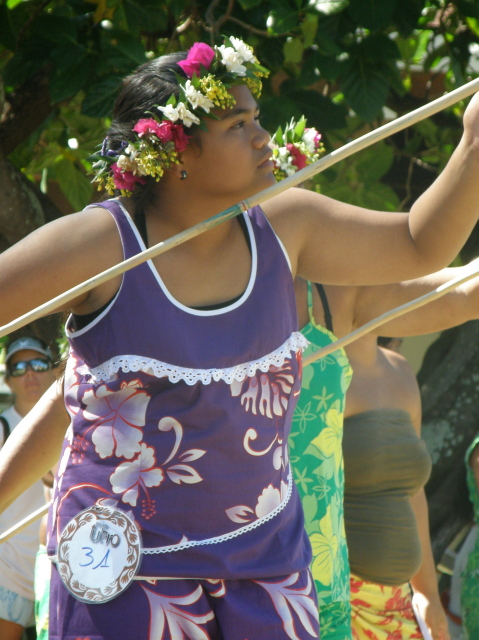
We visited the Musee de Tahiti which has a good display of artefacts from the area. While there we found out about the traditional games they were holding there on the weekend. We went along last Sunday, easily hitching a ride there as the public transport system here is not good. Local people seem quite used to picking up hitch hikers and delivering them exactly to their destination. The traditional games were fun to watch, especially the javelin tossing. Not like we are used to seeing: these javelins are aimed at a coconut positioned on top of a pole some 9 metres high. All the competitors throw at once and they are all kitted out in colourful team outfits (bien sur!).
Above & Below: images from the traditional games

Friday, June 29, 2012

Tahiti

Our passage from the Tuamotus to Tahiti was a quick one. We went through the Fakarava pass at 3.15pm on Monday, a bit after slack water. There was a little turbulence and we used the engine as well as sail just to ensure we stayed clear of the reef. The south easterly breeze was 20-30 knots and we were all (Good2Go, Slick & Gypsea Heart were also out there with us) reefing sail to both stay under control and slow down so we didn’t reach Tahiti in darkness. We tried to have a game of Scrabble during the day, but gave up as the sea was just too lumpy. We motored into Papeete Harbour at about 7.30am Thursday.

We are tied up at the Town Quay on a floating dock with quite a few other cruisers. It’s a very convenient place to be as we are less than 5 minutes walk along the waterfront from the centre of town. I, Louise, have been in ice-cream and shopping heaven since we arrived. The clothing stores are having sales in the lead up to Bastille Day (July 14) so it has also been a great opportunity to replace some of my fetid banana stained tops and shorts. It takes a cruise like this to discover just how badly banana sap stains clothes!
Just near the Town Quay is the area where the ‘roulottes’ set up each evening. These are vans from which you can buy your dinner and sit at the plastic tables they also provide. The food is reasonably cheap, good and plentiful and we have eaten there a few times, enjoying the Chinese food and crepes with ice-cream. It’s nice to dine out in the mild evening and take in the sights and sounds. Speaking of which, each night we hear drumming or singing or music. We think it is the local people practising for the Heiva which is a major cultural event for French Polynesia and goes from about now to Bastille Day.

It’s really nice to see how the traditional culture is also everyday eg. Men and women wearing flowers behind their ears, vibrantly coloured pareus (sarongs) and amazing shell and bone jewellery.

Moorea
We spent last weekend at the neighbouring island of Moorea. There is a mob here who put on events for the Puddlejumpers (us mob who are crossing the Pacific by sailboat). They organised a great weekend which started on the Friday night with cocktails, dancing and fire sticks. On the Saturday morning about 30 yachts sailed over to Moorea – they kept calling it a rally, not a race, but everyone looked like they were racing to me! We left Brio on the Quay and went over with and spent the weekend aboard ‘Watermusick’. The Musick family, Bill, Becky and kids Joseph, Raymond and Melody were very kind to let us ‘invade’ their space for the couple of days. But honestly it feels like such a big boat compared to ours, we never felt like we were in anybody’s way.
Team Water Musick
We did pretty well in the ‘not-race’, coming in at 7th place. The anchorage at Moorea is beautifully clear and has a stunning mountain backdrop. On the Sunday, we had a day of cultural sports and other activities, including outrigger races, tie-dying a pareo, banana carrying races, tug-of-war and dancing lessons. I just can’t seem to manage bending my knees one way while swivelling my hips the other way. The Polynesian women look so much more graceful and gorgeous when they do it.
Love that colour and movement!

Ivan's team won the outrigger races - Happy chappies!
Louise makes a pareo
Today is a public holiday in Tahiti for Independence or something like that. They call it the day of internal autonomy - sounds more like a surgical procedure to me. There are outrigger races going on just next to where we are on the Quay. People seem to have come from all over French Polynesia to participate and it is wonderful to see all the ‘colour and movement’ (as Dame Edna would say). The bodies, the costumes and the spectacular backdrop of Moorea island are all gorgeous.
Boys lining up for their race

Gorgeous girls - tres jolie

Tres jolie aussie


Wednesday, June 20, 2012

Tuomotus

We moved on from the verdant mountains and towering granite monoliths of the Marquesas to the Tuomotus group further south east. The geographic contrast couldn’t be greater: The Tuomotus comprise low lying, palm tree fringed coral atolls. The lagoons within the atolls are turquoise and aqua and lap upon brilliant white beaches. It is classic Pacific postcard and travel magazine cover imagery.
classic coral atoll scene

Our passage to the Tuomotus was 4 days and 4 nights to reach our chosen destination of Kauehi atoll. The sail across was fine, starting off in little or no wind and by the end of it dealing with squally, 30-40 knot winds. I mozzed us when I said as we were just about to enter the atoll through the pass in the reef that at least we hadn't had much rain with the squalls. As we motorsailed into the anchorage the skies thickened, the rain came in and it was grey all around. Not great conditions for seeing and avoiding the notorious coral heads that are in the atolls. But we knew it was a pretty easy pass to enter and could see most of what we needed to see on the chartplotter.
Speccy snorkelling

We celebrated my birthday here  -the big 50. I didn’t have the gourmet experience I was hoping for as there really is nothing but coconuts on these atolls, but I managed a chocolate brownie 'birthday cake' and we had a couple over from another boat to share a couple of bottles of red wine. The next evening a bunch of us got together on a catamaran (aka a palace) and feasted on fish and salads. Another chocolate cake was produced and I was sung 'happy birthday'.
a new 'do' for my 50th

After 4 or so relaxing days at Kauehi we moved on to Fakarava atoll. To ensure we got out the Kauehi pass as near to slack water as possible, we sailed up to the pass in the late afternoon to anchor just inside the pass for the night. There were 2 other yachts there doing the same thing. We had been undecided as to whether it was better to stay at our anchorage off the Kauehi village for the night and leave at 4.30am in the morning to get to the pass, or to spend the night anchored inside the pass, therefore only requiring a 6am start. To our regret we chose the latter. It was a very rolly anchorage and we got hardly any sleep, mostly because of the worry about whether the anchor would hold or the anchor rope would chafe, potentially letting us loose on the reef less than 20 metres behind us. As it turned out we survived the night, raised the anchor, still in the bucking seas, early the next morning and motored easily through the pass. We sailed in a south-easterly breeze of 12-16 knots, with quite rolly seas, the 30nm to Fakarava. As we were aiming to reach the northern pass of Fakara by about 1pm to get the end of the incoming tide, we turned the engine a couple of times to maintain an average speed of 5 knots. We came in through the pass at the expected time and sailed down to the anchorage off the town of Rotoava, dropping the anchor amongst about 10 other yachts at around 2.30pm.

As with the previous village we stayed at and in the Marquesas, the people who live here are very welcoming and generous. The villages are very clean and neat and while it is hard for people to grow a garden on the coral base in the Tuomotus, many houses have some bouganvillea, frangipani and assorted other plants around them.
the local boys gave Ivan a fishing lesson

We hired bikes for a day and rode the length of the bitumen and beyond. In one direction from the town the sealed road stretches for 16km and then continues for about another 5km. There wasn’t much to see along the way other than some houses and pensions and of course the ubiquitous coconut palms! We enjoyed the exercise though. Because the nature of coral atolls is that they are circular and narrow, we could usually see either the lagoon side or the ocean side of the atoll at any one time. The width of the atoll is probably only about 500m on average. In the other direction from town, the sealed road only goes for about 3km – to the airport. Most people come to the Tuomotus for the diving and snorkeling. I came for the chance to ride a bike on an airport runway – not many places in the world you can do that!
another baguette about to be devoured

After a really interesting tour of a pearl farm, including the purchase of a belated birthday present for me, we set sail for Tahiti.


Miss allie pic

The Marquesas

We spent 11 days in the Marquesas, exploring 3 different locations. We could have spent weeks there of course, but we really are trying to get this little boat home to Australia. Anyway, if I was to be a ‘live-aboard’ it would definitely have to be on a 45ft catamaran, complete with shower, a decent sized bed and communication systems that don’t involve standing on one leg, at a 45 degree angle holding the satellite phone out the hatch while the rain comes in! Ok, maybe that last one was a bit of an exaggeration.

Back to the Marquesas…..we arrived in Taiohae Bay, Nuku Hiva in the early afternoon on Thursday 24 May. We had a big sleep that night and the next morning rowed the dinghy (our crappy second hand outboard has spat the dummy and Ivan likes the exercise) to the dock and walked up the pretty little street, passports and boat papers in hand to check in with the Gendarmes. The Gendarme who checked us in had only arrived on the island from Paris a few days prior. Apparently they have to do a 3 month stint in a French outpost every couple of years. We said he must have felt very lucky to have been posted to such a beautiful place. He looked at us like we were crazy. I guess the Marquesas are a bit quiet for a boy who’s grown up in Paris!
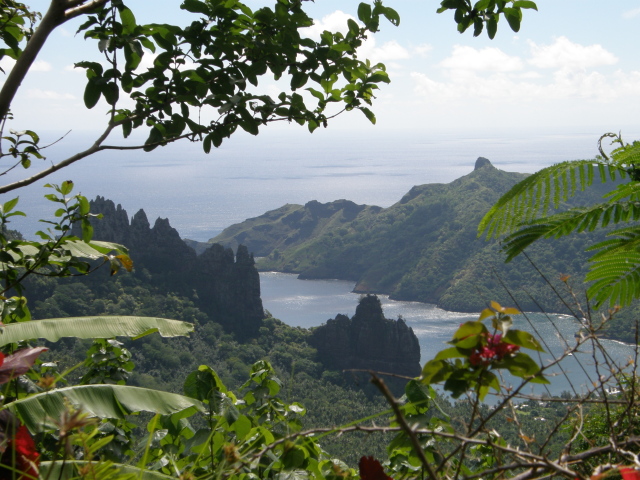
Approaching Nuku Hiva

My brain and belly have both switched gears since leaving the Galapagos. I have caught myself on more than one occasion saying “gracias” instead of “merci” or “hola” instead of “bonjour”. It’s hard to shake off months of Spanglish, replacing it overnight with rusty schoolgirl French. Still, it keeps the brain plastic they say! As for my belly –baguettes, brie, pate and chocolate mousse – I was in heaven! A big topic of conversation amongst cruisers is food – what is available and where and when to get it. It is extreme in the Marquesas (and the Tuomotus) where fresh food is hard to come by. We love visiting markets wherever we are, but having to get to the Taiohae Bay market at 4am just to get some veggies is ridiculous! By 5am it’s all sold out. We did it though and came away with avocadoes, lettuce, tomatoes, bok choy and some fruit while others who arrived later came away with “nada” oops “rien”.

We did a tour of Nuku Hiva with another couple. It was really interesting to learn the history of the island from Richard, our guide, as well as hear about current social issues they face. The island only schools children up until abut year 9. After that they have to go to Tahiti to continue their education. Richard’s daughter is only 6 years old now, but he is already worrying about sending her off on her own to Tahiti as a 14 year old.
A pretty top view

We celebrated Ivan’s birthday in Hakaui (or Daniel’s) Bay. It is a relatively calm anchorage, surrounded by towering mountains and the feeble bleats of wild goats. A handful of families live in the bay. They grow fruit and some vegetables that are shipped to Tahiti every couple of weeks via the cargo/passenger ship Aranui. We asked a local couple to prepare a Marquesan feast for us and 8 others for Ivan’s birthday. It was a great afternoon featuring shrimps in coconut sauce, taro, green bananas, manioc, a salad of watercress and cucumber and banana turnovers for dessert. There was also a coconut husking session - it's not as easy as it looks!

Let the party begin!

From Hakaui Bay we day sailed across to the island of Ua Poa and spent a couple of nights in quite a rolly anchorage there. The dinghy landing there was a challenge as there was a huge swell at the dinghy dock. We just had to leap out very quickly and then drag the dinghy up onto the dock before the surge dragged it away from us. The village here was a little larger than the one at Hakaui Bay and even boasted a primary school and a shop. We were met at the dock by a guy who led us up the road to his family's fruit farm where we spent a couple of hours, talking, watching him make coconut milk and finally purchasing some fruit. It was nice to be able to have a freshwater shower at this village, even if it was just a stream of water coming out of a pipe in full view of everyone next to the dinghy dock!

Ivan chats to the neighbours while the granite looks on


Wednesday, May 30, 2012

Passage to Maquesas


Well we made it! 23 days and  3,000 nautical miles later we arrived at Taiohae Bay on the island of Nuku Hiva in the Marquesas group. It was very refreshing for our eyes to see lush green vegetation after more than 3 weeks of ocean, ocean and more ocean all around. During our passage we averaged 5.8 knots and 130 nautical miles for each 24 hour period. Not bad at all we think for a small, heavy boat.
Not always blue skies

We both agreed that while the passage was never boring, there was always something to do or fix, it became somewhat monotonous and we quickly slotted into a daily routine. A typical day went something like this: Ivan came off watch at 9am and would make us breakfast. He consistently had muesli while I decided on the day – muesli or fruit and yoghurt and/or toast. If I didn’t need to be on deck all the time while on watch, and heel of the boat permitting, I would then make some bread if we needed it and also start to organise lunch. I figured it was best to do as much foodwise in the galley as possible while conditions were good, because you never knew when it would all change and the galley turn into a gunnel to gunnel rolling nightmare.

We decided early on in the passage to make lunch our main mean of the day. I prepared 90% of the meals and I was finding that the preparation and clean up of a big meal in the evening, before those long night watches, was cutting into the rest time I needed to get ready for the night ahead.

Our night watches weren’t actually any longer than our day watches –3 hours each – they just seemed longer. By the end of 3 hours, in the dark of night, I was well and truly ready to hand over to Ivan. I fairly quickly exhausted my supply of Radio National podcasts I had downloaded in Panama and so I would listen to music or read to keep awake and help pass the time when on watch. My meagre supply of music started to get a bit repetitive though. I was also amazed at how many songs I have that have “ocean”, “sea” and other nautical words as lyrics. One songster even mentions “man overboard” a few times. Hmmm, I’m not too keen to listen to that one anymore!

Our other major activities most days were an afternoon game of Scrabble, reading, watching the fishing line for tell-tale jerks that there was something edible on the end of it, and checking in with a couple of different SSB radio nets. Actually that was Ivan’s pastime more than mine. He calls it his networking time. I call it his social addiction. Flippancy aside, the radio nets have been extremely useful (as well as re-assuring to know there are at least 20-30 other yachts out there like us, making their way across the Pacific Puddle).
Nuku Hiva at last!

We had pretty good weather during the passage – typical south easterly trade winds of 10-15 knots, some squalls and the seas ranged from a ½ metre swell to a 3 metre swell. We had about 5 days in the middle of the passage where the seas were large and confused which made for very uncomfortable sailing and put a lot of strain on the rigging as the boom would bang around even though we had tied a restraining rope to it and the reacher sail would flog. For much of the passage we sailed using the reacher only as that seemed to balance the boat best for using the wind monitor (which meant we didn’t have to hand steer all the time).

Brio coped with it all pretty well. Our major problem was when our outer forestay gave way. Fortunately Brio has two forestays – one of the things Ivan liked about her when he first saw her – which also fortunately meant that when the forestay broke the mast didn’t come crashing down! The forestay gave way during pretty calm weather, but it was probably all of the flogging and banging that caused the breakage. To cut a long story short, we were able to drop the forestay, the aluminium track it is housed within and the sail alongside the deck and lash it all onto the side rail. With some grunting and sweating we removed the sail from the track and threw it down into the cabin and then got back on course with a 10 foot extension now hanging off the rear of our 33 ft. For the rest of the passage we had to use the inner forestay with the smaller genoa sail and we hoisted the main for balance. It meant we were probably travelling a bit slower, but at least we were moving! Now we have arrived at a port where we can use email and telephone, we will set about ordering a replacement furler mechanism that dropped overboard when the forestay came down and a new forestay. Papeete in Tahiti will be our best chance to get the parts and get the work done, so until then we will manage.
Brio on the high (flat) seas
Maintaining a good charge on our batteries has been a challenge. I suspect our fridge thermostat is on the blink and it is draining the batteries, although it could also be a problem with the batteries themselves. The electrics on Brio are a mystery to us. To keep the batteries charged during the passage we were running the engine for 2-3 hours each day and that would only give us enough power to keep the chartplotter and fridge going. We didn’t use our cabin lights or watch dvds so it really felt like a camping experience!

Our fresh food lasted more than 2 weeks and when we arrived here at Taiohae Bay we still had oranges, limes, potatoes, yucca, onions, cabbage, garlic and eggs. Just as well as our fishing skills need improving, having caught only one fish (a mahi mahi) during the entire passage. That’s not counting the little flying fish that would sacrifice themselves on our deck most nights. Ivan collected them to cook up (as I refused to deal with the desiccated little bodies), but never did, so we gave them to someone’s cat the other day.

We didn’t see much else in the way of wildlife while we were out there: a pod of about 100 dolphins one afternoon and the occasional bird looking for a place to land on Brio. The only other boats we saw were the lights of two fishing boats in the distance one night and early in the passage we were passed (within 20 metres!) by a 58ft catamaran called Unama. We talked with them on the VHF radio and each took photos of the other boat under sail exchanging email addresses to send them on. As luck would have it, Unama came into this anchorage yesterday and we handed over our photos. They of course only took a very respectable 15 days to make the passage from Galapagos.
Unama passing us at a great rate of knots

Now we must get on with the business of exploring Nuku Hiva!